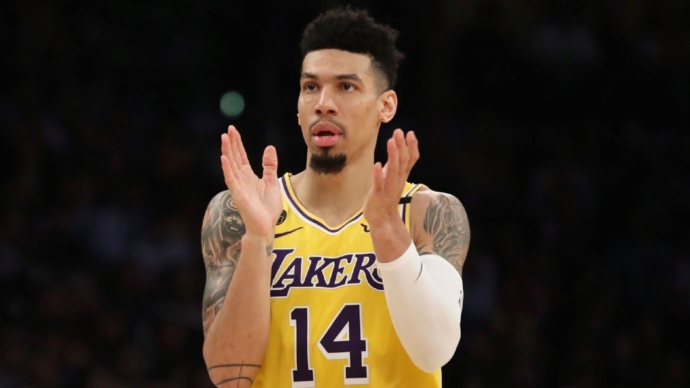
“We don’t see it as often than we used to”: Danny Green cites elite 3-and-D guys
The term “3-and-D” has long been one of the most valuable archetypes in modern basketball. It refers to players who can knock down the three-pointer consistently while also defending at a high level on the perimeter. The idea was never just about specialists who could only do one thing. True 3-and-D players were those who could space the floor offensively while also holding their ground defensively against elite scorers.
That role defined Danny Green’s career.
Green built a reputation as one of the most reliable players in that mold. A three-time NBA champion with the San Antonio Spurs, Toronto Raptors, and Los Angeles Lakers, he became known for his ability to stretch defenses with timely three-point shooting while also guarding the opposing team’s best perimeter player.
During championship runs, Green’s value often came from the balance he provided. Offensively, his shooting forced defenses to stay honest and opened space for star teammates to attack. Defensively, his discipline and positioning allowed him to take on difficult assignments without sacrificing team structure.
According to Green, players who truly excel in both areas have become less common.
“We don’t see it as often as we used to,” he said, reflecting on the classic definition of the 3-and-D role.
Green recently visited the Philippines as part of an initiative to support local partnerships and fan engagement in collaboration with NBA Store PH. During the visit, he interacted with fans and discussed various aspects of the modern game, including how the role he once thrived in has evolved.
3x NBA champion (Spurs, Raptors, Lakers) Danny Green is in the Philippines to support local partner engagements and interact with fans @basketbllnews pic.twitter.com/4Kjp7XnMDv
— Mon Anthony Valmoria (@MorvalNBA) March 13, 2026
In today’s NBA, the game has shifted toward more ball-dominant creators and versatile offensive engines. Many players are asked to do more than simply space the floor and defend. They initiate offense, handle the ball in pick-and-roll situations, and create their own scoring opportunities. While that versatility is valuable, it has also blurred the lines of what a traditional 3-and-D player looks like.
Despite that shift, Green pointed out that there are still players in the league who embody the spirit of the role, even if their responsibilities extend beyond it.
Among the names he mentioned were Jaylen Brown, Shai Gilgeous-Alexander, Cade Cunningham, and Victor Wembanyama, and each of those players fits the description in different ways.
3-time NBA champion Danny Green on who he thinks are the top 3-and-D players in the NBA today: “Jaylen Brown, SGA, Cade Cunningham, all these guys that we watch that are MVP candidates, Victor Wembanyama.” @basketbllnews pic.twitter.com/wbECdJ8E8K
— Mon Anthony Valmoria (@MorvalNBA) March 13, 2026
Brown has built his reputation as one of the league’s premier two-way wings. He can score at all three levels while also defending multiple positions with physicality and athleticism. His ability to knock down perimeter shots while guarding top wings reflects the modern evolution of the 3-and-D role.
Gilgeous-Alexander, while primarily known for his offensive brilliance, has also developed into a disruptive defender with strong instincts and length. Cunningham’s size and versatility at the guard position allow him to contribute defensively while spacing the floor when needed. Wembanyama represents perhaps the most unique version of the concept, combining elite rim protection with the ability to stretch the floor from beyond the arc.
What these players represent is the modern version of the archetype. They are not limited to standing in the corner waiting for a kick-out pass or focusing solely on defensive assignments. Instead, they incorporate shooting and defense into a broader skill set that includes playmaking and scoring creation.
Green’s perspective carries weight because he spent more than a decade mastering the role at the highest level. His shooting helped swing playoff games, and his defense allowed championship teams to maintain balance on both ends of the floor.
The league may be evolving, but the core value of the 3-and-D concept remains the same. Players who can space the floor while defending at a high level will always be essential pieces for winning teams.
Even if the role looks different today, its importance has not disappeared. According to Green, the players who can truly do both at an elite level are still among the most valuable in the game.