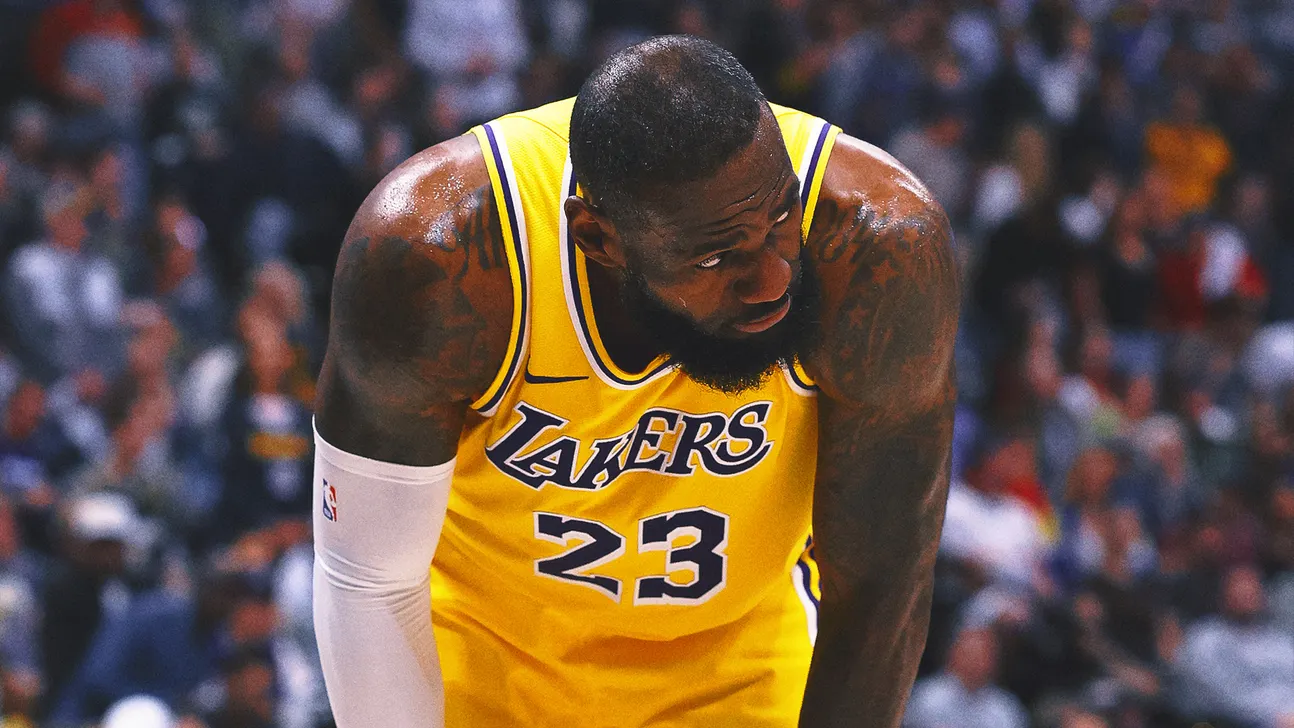
LeBron James faces unprecedented burden as Lakers enter playoffs shorthanded
The Los Angeles Lakers are heading into the postseason with more questions than answers, and the biggest one sits at the center of everything they hope to accomplish.
How much can LeBron James still carry?
This was never supposed to be the path. Not for a team that envisioned itself as a contender built on star power, depth, and versatility. Not for a roster that leaned into the idea of multiple creators sharing the load, allowing its oldest player to pick his spots rather than dictate every possession. And certainly not for a 41-year-old who has already rewritten the boundaries of longevity.
Yet here they are.
With Luka Dončić and Austin Reaves both sidelined indefinitely due to injuries, the Lakers are entering a playoff series against the Houston Rockets stripped of their offensive balance. What remains is a reality that feels almost surreal. The burden does not simply shift. It collapses entirely onto one player.
LeBron James.
At 41 years old.
The weight of everything
There have been great players asked to carry enormous loads before. The history of the NBA is filled with stars who have dragged undermanned teams through the playoffs, elevating flawed rosters through sheer brilliance and will. That part is not new.
What is new is the age.
LeBron is not just a veteran. He is operating in a space that no one in league history has occupied with this level of responsibility. Players at this stage of their careers are supposed to be role players, situational contributors, or locker room presences. Even the greatest legends eventually transitioned into smaller roles, their impact measured in moments rather than sustained dominance.
LeBron has refused that trajectory.
Instead of scaling down, he has remained the system. Instead of fading, he has sustained a level of control that still bends defenses, dictates tempo, and defines outcomes. Now, with the Lakers stripped of two primary creators, that responsibility expands even further.
Every possession will begin with him.
Every adjustment will run through him.
Every ounce of hope will depend on how much he has left.
A different kind of challenge
This is not simply about scoring more points or playing more minutes. It is about absorbing the entirety of an offense against a playoff defense designed to exploit every weakness.
The Rockets are young, athletic, and relentless. They will pressure the ball, collapse the paint, and dare other Lakers to beat them. They will test LeBron’s legs, his decision-making, and his endurance across a full series. And unlike previous years, there is no secondary engine to ease that strain.
Without Dončić, the Lakers lose their primary initiator in the half court. Without Reaves, they lose a connective piece who thrives in secondary actions and late-clock situations. Those absences do not just remove production. They eliminate layers of optionality.
What remains is simplicity, and simplicity in the playoffs often becomes predictability.
That is the challenge in front of LeBron.
He has to be brilliant while being predictable.
He has to create advantages when the defense knows exactly where the ball is going.
He has to sustain it for an entire series.
The physical toll
At any age, this would be demanding. At 41, it becomes something else entirely.
There is a physical cost to controlling every possession. It shows up in the legs, in the recovery time between games, and in the small moments that accumulate over the course of a series. The playoffs are not just about peaks. They are about consistency under fatigue.
LeBron has spent two decades managing his body better than anyone in league history. His preparation, discipline, and understanding of pacing have allowed him to extend his prime well beyond what anyone thought possible. But even for him, there are limits.
The question is not whether he can deliver a great game. He has proven that repeatedly.
The question is whether he can do it four times.
Against a defense built to stop him.
With minimal support.
The mental burden
The physical aspect is only part of the equation. The mental load might be even heavier.
LeBron is not just a scorer or a playmaker. He is the Lakers’ strategist on the floor. He reads defenses in real time, adjusts spacing, directs teammates, and orchestrates every phase of the game. When the roster is healthy, those responsibilities are shared. Now, they are centralized.
Every decision matters more.
Every mistake carries greater weight.
There is no margin for drift or disengagement, not even for a possession.
This is where LeBron’s experience becomes both a weapon and a necessity. He has seen every coverage, every adjustment, every playoff wrinkle imaginable. He understands the rhythm of a series and the importance of controlling tempo. He knows when to attack and when to conserve energy.
But knowledge does not eliminate effort. It only sharpens how that effort is applied.
And the effort required here is immense.
The historical context
It is difficult to find a true comparison for what LeBron is being asked to do.
Michael Jordan never carried this kind of load at this age.
Kobe Bryant did not operate at this level of responsibility in his 40s.
Kareem Abdul-Jabbar, despite his longevity, was not tasked with being the singular engine of a playoff team this deep into his career.
LeBron stands alone in this context.
That is not hyperbole. It is simply the reality of his career arc. He has extended the definition of a prime, reshaped expectations around aging, and now finds himself in a situation that demands something unprecedented.
A 41-year-old as the sole offensive engine of a playoff team.
It should not be possible.
And yet, with LeBron, the conversation is never about possibility alone. It is about probability.
The supporting cast question
For the Lakers, survival in this series cannot rely solely on LeBron’s brilliance. Even if he delivers at an elite level, the margins are too thin without contributions from the rest of the roster.
Someone has to step into the void.
Role players will have to make shots, defend with discipline, and capitalize on the attention LeBron draws. The spacing must hold. The transition defense must be sharp. The small details that often go unnoticed will decide whether this becomes a competitive series or a short one.
But the reality remains clear.
Those contributions will be reactive.
LeBron’s performance will be the driver.
The emotional weight
There is something inherently compelling about this moment, beyond the tactical and statistical layers.
It is the image of a player who has already accomplished everything being asked to do more.
It is the idea of greatness not as a static achievement but as a continuous act of defiance against time.
LeBron does not need this series to validate his legacy. That conversation was settled long ago. Championships, records, and sustained excellence have already secured his place among the greatest to ever play.
And yet, he continues.
Not because he has to, but because he can.
Because somewhere within him, the standard has never changed.
What success looks like
For the Lakers, success in this context has to be defined differently.
It is not just about winning the series, although that remains the ultimate goal. It is about competitiveness, resilience, and the ability to push a more balanced team to its limits. It is about forcing the Rockets to adjust, to feel pressure, to acknowledge that this is not simply a mismatch.
For LeBron, success may be measured in moments.
A dominant fourth quarter.
A game where he controls every aspect from start to finish.
A stretch where he bends the series in a way only he can.
Those moments matter, even if the outcome does not fully align with expectations.
The legacy layer
Every postseason adds another chapter to LeBron’s career, but this one carries a different kind of weight.
It is not about building his case. It is about expanding it into territory that no one else has reached.
If he manages to carry this Lakers team beyond expectations, it will stand as one of the most remarkable feats of his career. Not because of the stakes alone, but because of the circumstances.
Age. Injuries. Responsibility. All converging at once. Even the attempt adds to his legacy.
The reality of the moment
There is a temptation to frame this as a fairytale setup, a stage for another iconic LeBron run. And while that possibility cannot be dismissed, the reality is more grounded.
This is difficult. This is demanding.
This is the kind of challenge that exposes limitations as much as it highlights greatness.
The Rockets are not going to yield out of respect for history. They will attack, pressure, and force the Lakers into uncomfortable situations. They will test every assumption about what LeBron can still do.
That is the nature of the playoffs.
And yet, there is LeBron
Despite all of that, there remains a sense of possibility that is unique to him.
It exists because he has done the improbable before.
It exists because he continues to operate at a level that defies conventional understanding.
It exists because when the burden becomes overwhelming, he has a history of finding another level.
This is not blind belief. It is earned.
The final thought
The Lakers enter this series undermanned, uncertain, and reliant on something that has never been asked of a player at this stage of his career.
A 41-year-old leading every possession. A 41-year-old carrying an entire offense. A 41-year-old being the difference between contention and collapse. It should not be possible.
But if there is one player in the history of the NBA who could make it feel that way, it is LeBron James. And now, the playoffs will ask him to prove it once more.