Why the Rookie Wall Is Real: The Physical Toll of an 82-Game NBA Season
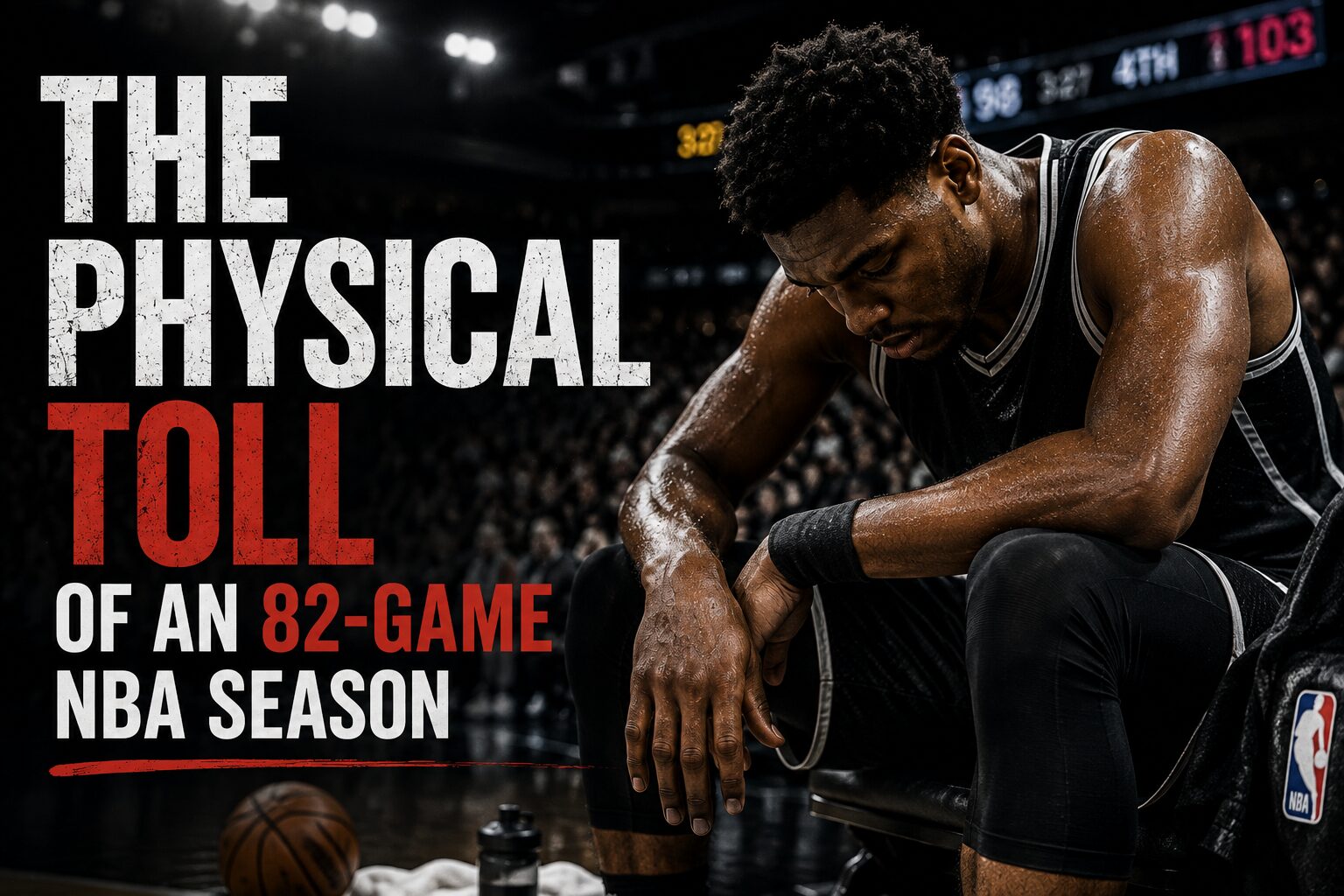
A rookie looks explosive and sharp through his first fifteen or twenty games, then visibly slows down right around late December, missing shots he was hitting with ease a month earlier and looking a step behind on defense. Analysts call it the rookie wall, as though it were some mysterious rite of passage every first-year player simply has to endure. The physical explanation behind it is considerably more specific than that, and it has everything to do with a workload most rookies have never experienced before.
The college season a rookie just left behind rarely exceeds thirty-five or forty games, including tournament play, spread across roughly five months with real breaks built in around exams and holidays. An NBA season runs 82 games in about six months, with stretches of four games in five nights that simply do not exist in the college calendar. Nothing in a typical college workload prepares a player's body for that kind of density
until he actually lives through it.
Travel compounds this gap considerably. A college team might take a handful of true cross-country trips across an entire season, while an NBA rookie crosses multiple time zones almost every week from October through April. The cumulative toll of that travel, layered on top of the increased game volume, is part of why the wall tends to show up around the same point on the calendar for so many first-year players.
Nutrition becomes one of the more practical levers a rookie has to manage this jump in workload. A shake built around fast-digesting whey protein powder gives the body quick access to amino acids for muscle repair between games, a real factor for a player logging heavy rotation minutes across a stretch of four games in five nights for the first time in his life. Veteran players who have already been through several full NBA seasons tend to have this kind of routine locked in well before training camp even starts,
while rookies are often still building the habit from scratch during their first year.
The broader case for prioritizing protein intake during a demanding season rests on solid research. A large meta-analysis published in the British Journal of Sports Medicine pooled data from 49 randomized trials and roughly 1,863 participants and found that protein supplementation produced measurable gains in lean mass and strength when combined with resistance training. The researchers identified a daily intake of around
1.6 grams per kilogram of body weight as the point past which additional protein stopped producing extra benefit in the pooled data, a target that becomes considerably harder to hit through meals alone once a rookie is playing and traveling at NBA volume
for the first time.
Sleep debt accumulates in a particular way during a rookie season that veterans have generally already learned to manage. A rookie excited about simply being in the league, handling media obligations and adjusting to a new city, often does not protect his sleep schedule as carefully as a tenth-year veteran who has already learned the hard way what happens when rest gets deprioritized during a long season. This gap compounds quietly over the first two or three months before becoming visible in declining performance.
Strength and conditioning staffs have gotten better at flagging this decline early using workload data rather than waiting for it to show up on the stat sheet. Wearable trackers worn during practice log distance, jump count, and high-intensity movements, allowing a team to spot when a rookie's cumulative workload is climbing toward levels associated with real performance decline before fatigue fully sets in. A rookie flagged this way might see reduced practice reps or a lighter shootaround, an adjustment that would have been unheard of a generation ago.
Recovery technology fills out the rest of a modern team's response to this challenge. Ice baths and compression therapy remain standard, and increasingly hyperbaric chambers have become part of the toolkit some teams and players use to manage cumulative fatigue during the heaviest stretches of a demanding season. None of these tools replace the underlying adjustment period every rookie has to go through, but they give a
young player's body extra support while that adjustment is still happening.
Second-year players almost universally describe the wall as far less severe the following season, once a full year of NBA volume has already reset their baseline understanding of what the schedule actually demands. This pattern is consistent enough across the league that most front offices treat a rookie's late-season decline as an expected, largely physical phenomenon rather than a red flag about a player's long-term potential or work ethic.
International rookies face a somewhat different version of this challenge, since many arrive already accustomed to a demanding professional schedule in a top European league. Even so, the specific combination of NBA travel distances and back-to-back
game frequency rarely has a direct equivalent anywhere else in the world, meaning even an experienced international player often needs a real adjustment period despite years of professional experience elsewhere. Front offices increasingly account for this distinction when planning a first-year international player's workload rather than assuming his prior professional experience fully prepared him for the NBA specifically.
Position also plays a role in how severely the wall shows up for a given rookie. A ball-handling guard logging heavy minutes tends to accumulate fatigue differently than a big man whose workload involves more contact but fewer total high-speed movements across a game, and strength staffs increasingly tailor recovery plans to these positional differences rather than applying an identical maintenance program across every rookie
on the roster.
Two-way and G League assignments complicate this picture further for rookies who bounce between levels during their first season. A player shuttling back and forth between an NBA roster and its G League affiliate deals with an even more irregular travel and rest pattern than a full-time rotation rookie, often with less consistent access to the recovery infrastructure available at the main NBA facility. Front offices that invest
in extending proper sports science support to their G League affiliate tend to see their two-way players handle this irregular schedule considerably better than those where the G League setup is treated as a clear step down in resources.
Summer League and pre-draft workouts, for all the attention they get from evaluators, do very little to prepare a player's body for what an 82-game season actually demands, since neither comes close to replicating the cumulative volume of a full professional
season. This gap is part of why a player can look completely ready during Summer League only to still experience a real physical decline once the regular season workload sets in for the first time.
None of this makes for a flattering storyline compared to simply saying a rookie hit a wall, which is exactly why the physical explanation gets so little attention in typical season coverage. The player who avoids the steepest version of that decline is very often the one who treats sleep, nutrition, and recovery as seriously as his on-court development from day one, rather than assuming talent alone will carry him through a schedule unlike anything he has faced before.